This article has been reviewed for factual accuracy based on USDA nutritional data and established health guidelines. Content is for informational purposes only and does not replace professional medical advice , consult a qualified professional.
If you want to lose weight but don’t know where to start, walking is one of the simplest ways to become more active. You don’t need a gym membership, expensive equipment, or complicated workouts. A consistent walking routine can help you increase daily activity and support a healthy weight when combined with nutritious eating.
This 7-day walking plan for weight loss is designed for beginners. It gradually increases your walking time and introduces short periods of brisk walking without making the first week unnecessarily difficult.
If you’re completely new to walking for exercise, use this plan as a starting point rather than trying to walk for hours from day one.
Want the bigger picture? Read our complete guide: Walking for Weight Loss: How Much Should You Walk to Lose Weight?
What Is a 7-Day Walking Plan for Weight Loss?
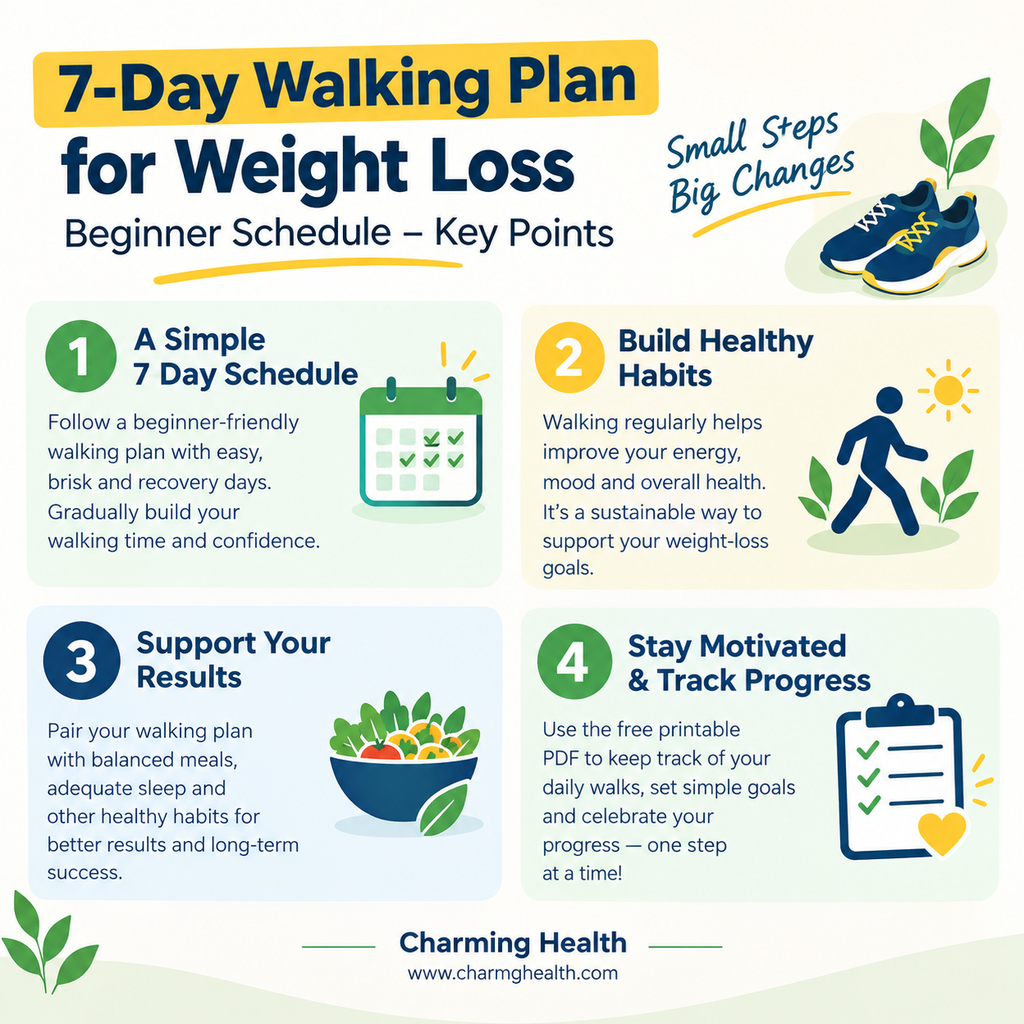
A 7-day walking plan is a simple weekly schedule that tells you how long to walk, how hard to walk, and when to recover.
For beginners, the goal isn’t to burn as many calories as possible in one week. The goal is to create a routine that you can continue.
This plan combines:
- Easy walking
- Brisk walking
- Short walks after meals
- Longer walks
- One lighter recovery day
- Gradual increases in walking time
The CDC recommends that adults get at least 150 minutes of moderate-intensity aerobic activity per week, and brisk walking can count toward that goal. However, beginners don’t necessarily need to start at 150 minutes immediately. Starting slowly and building up is a practical approach.
Can Walking Help You Lose Weight?
Yes, walking can contribute to weight loss because physical activity increases the amount of energy your body uses.
However, walking alone doesn’t guarantee weight loss.
Your overall calorie intake, food choices, sleep, activity level, age, body composition, and other factors can affect your results. The CDC notes that weight loss generally involves creating a calorie deficit through a combination of physical activity and managing calorie intake.
That’s why it’s better to think of walking as one part of a healthy weight-loss lifestyle rather than a quick fix.
For more help with food choices, see our 7-Day Weight Loss Meal Plan: High-Protein, High-Fiber & Easy.
Your 7-Day Walking Plan for Weight Loss
Here’s a simple beginner schedule you can follow at home, around your neighborhood, on a treadmill, or in a park.
| Day | Walking Plan | Time | Intensity |
|---|---|---|---|
| Day 1 | Easy walk | 20 minutes | Easy |
| Day 2 | Brisk walking intervals | 25 minutes | Easy + brisk |
| Day 3 | After-meal walking | 25 minutes total | Easy/moderate |
| Day 4 | Brisk continuous walk | 30 minutes | Moderate |
| Day 5 | Recovery walk | 20 minutes | Easy |
| Day 6 | Longer walking session | 35 minutes | Moderate |
| Day 7 | Easy + brisk intervals | 30 minutes | Easy + brisk |
Total planned walking time: 185 minutes
You don’t have to complete every minute continuously. If your schedule is busy, you can split a walk into shorter sessions.
Who Should Modify This Walking Plan?
This 7-day walking plan is designed for generally healthy beginners, but it can be adjusted based on your current fitness level, health, and daily routine.
- New to exercise? Start with shorter walks and gradually increase your walking time as your fitness improves.
- Have a health condition? If you have heart disease, diabetes, arthritis, or another chronic health condition, talk with your healthcare professional about the type and amount of activity that’s appropriate for you.
- Experiencing pain or unusual symptoms? Reduce the intensity or stop exercising and seek medical advice if you experience chest pain, severe shortness of breath, dizziness, or other concerning symptoms.
- Already active? You can gradually increase your walking duration or add more brisk intervals rather than starting at the beginner level.
- Limited time? You don’t have to complete your entire walk at once. Splitting your walking into shorter sessions throughout the day can make the plan easier to follow.
Remember: The goal is consistency, not perfection. Start at a comfortable level and gradually build your walking routine over time.
Day 1: Start With a 20-Minute Easy Walk
Goal: Build the habit without exhausting yourself.
Start with a comfortable 20-minute walk.
You should be able to breathe comfortably and hold a normal conversation.
Don’t worry about speed, steps, or calories today. Your main goal is simply to get moving.
Try this:
- 5 minutes easy walking
- 10 minutes comfortable walking
- 5 minutes easy walking
If 20 minutes feels too difficult, start with 10–15 minutes and gradually increase your time.
The CDC recommends starting slowly and working toward more activity over time.
Beginner tip: Put your walking shoes somewhere visible. Making your walking routine easy to remember can help turn it into a habit.
Day 2: Add Short Brisk-Walking Intervals
Goal: Introduce a slightly faster pace.
Today, you’ll alternate between comfortable walking and brisk walking.
Try this 25-minute workout:
- 5 minutes easy warm-up
- 2 minutes brisk walking
- 3 minutes easy walking
- Repeat the brisk/easy cycle 3 times
- 5 minutes easy walking to finish
During brisk walking, your breathing and heart rate should increase, but you should still be able to talk.
Brisk walking is considered a moderate-intensity activity.
You don’t need to walk as fast as possible. The goal is a pace that feels noticeably harder than your normal stroll.
Day 3: Try an After-Meal Walk
Goal: Break up long periods of sitting and make walking part of your daily routine.
Instead of doing one longer workout, divide today’s walking into smaller sessions.
For example:
- 10-minute walk after breakfast
- 10-minute walk after lunch
- 5-minute easy walk after dinner
Or simply take one 25-minute walk at a convenient time.
Short walks can be useful when finding a full 30-minute block is difficult. The CDC also recommends reducing sedentary time and adding movement throughout the day.
Simple habit: If possible, take a short walk after a meal instead of immediately sitting down.
Day 4: Walk Briskly for 30 Minutes
Goal: Build your moderate-intensity walking time.
Today is your first longer continuous brisk walk.
Try this:
- 5 minutes easy walking
- 20 minutes brisk walking
- 5 minutes easy walking
Your brisk pace should feel purposeful but sustainable.
You shouldn’t feel like you’re running.
A useful rule is the talk test: during moderate-intensity activity, you can generally talk, although your breathing is faster than during an easy walk.
If 20 minutes of brisk walking is too challenging, reduce the brisk portion and add more easy walking.
Day 5: Take an Easy Recovery Walk
Goal: Keep moving without pushing your intensity.
Today is intentionally easier.
Take a relaxed 20-minute walk.
You can walk:
- Around your neighborhood
- In a park
- On a treadmill
- Around a shopping mall
- On a safe walking route near your home
The purpose isn’t to burn as many calories as possible. It’s to maintain your walking habit while giving yourself a lighter day.
If you’re feeling unusually tired or sore, it’s also reasonable to reduce the duration.
Consistency matters more than having a perfect week.
Day 6: Take Your Longest Walk
Goal: Gradually increase your walking endurance.
Today you’ll complete a 35-minute walk.
Try this:
- 5 minutes easy
- 10 minutes comfortable
- 15 minutes brisk
- 5 minutes easy
This gives you a longer session without requiring you to walk briskly for the entire time.
If 35 minutes is too much for your current fitness level, split it into two shorter walks.
For example:
20 minutes in the morning + 15 minutes in the evening
There is no requirement that every walking session must happen at once.
Day 7: Finish With Easy + Brisk Intervals
Goal: End the week with a balanced walking workout.
Your final session combines comfortable walking with short brisk intervals.
Try this 30-minute routine:
- 5 minutes easy walking
- 3 minutes brisk walking
- 2 minutes easy walking
- Repeat 4 times
- 5 minutes easy walking
This is a good way to finish your first week because you’re practicing both endurance and pace without turning the workout into a running session.
After completing Day 7, take a few minutes to think about which walks felt easiest and which ones you enjoyed most.
That information can help you build your next week’s routine.
7-Day Walking Plan at a Glance
Save this table so you can easily refer to it during the week.
| Day | Duration | Workout |
|---|---|---|
| Monday | 20 min | Easy walk |
| Tuesday | 25 min | Brisk intervals |
| Wednesday | 25 min | Short after-meal walks |
| Thursday | 30 min | Brisk walk |
| Friday | 20 min | Easy recovery walk |
| Saturday | 35 min | Longer walk |
| Sunday | 30 min | Easy + brisk intervals |
Weekly total: 185 minutes
This schedule is slightly above the commonly recommended 150 minutes of moderate-intensity activity per week, but remember that not every minute in this beginner plan is brisk or moderate intensity.
If you’re starting from very little activity, you can reduce the times and gradually build toward this schedule.
How Fast Should You Walk to Lose Weight?
There isn’t one perfect walking speed for everyone.
Your ideal pace depends on your current fitness level, age, body size, terrain, and experience.
For general health, brisk walking is commonly considered moderate-intensity activity. A practical way to judge intensity is the talk test: you should be breathing faster, but still able to carry on a conversation.
Instead of worrying about hitting a specific speed, try these three levels:
Easy pace
You can comfortably talk and don’t feel particularly challenged.
Comfortable pace
You’re moving faster than a casual stroll but can still walk for an extended period.
Brisk pace
Your breathing and heart rate are noticeably higher, but you can still talk.
For beginners, spending some time at each level is often more practical than trying to maintain a fast pace throughout the entire workout.
Should You Walk in the Morning or Evening for Weight Loss?
The best time to walk is usually the time that fits your schedule and that you can repeat consistently.
Morning walking
A morning walk can help you start your day with movement and may be convenient before work or other responsibilities.
Evening walking
An evening walk can be an easy way to add activity after work or dinner.
After-meal walking
Short walks after meals can also help you break up long periods of sitting.
There is no need to believe that one particular time of day automatically causes more fat loss. Your overall activity and eating pattern matter more than whether you walk at 7 AM or 7 PM.
How Many Steps Should You Walk for Weight Loss?
You don’t have to reach 10,000 steps a day to make walking worthwhile.
Ten thousand steps is a popular target, but there isn’t a universal step number that guarantees weight loss.
Instead, consider your current daily activity.
If you’re currently averaging 3,000 steps, trying to immediately reach 10,000 may feel unrealistic.
A better approach is to gradually increase your movement.
For example:
3,000 → 4,000 → 5,000 → 6,000 steps
Your exact target can depend on your lifestyle and fitness level.
For more information, see our main guide:
Walking for Weight Loss: How Much Should You Walk to Lose Weight?
7 Ways to Make Your Walk More Effective
Once your body becomes comfortable with regular walking, you can make your routine more challenging without turning it into a complicated workout.
1. Increase your walking time
Add 5–10 minutes to one or two walks each week rather than making a large jump.
2. Add short brisk intervals
Walk faster for 1–3 minutes, then return to your normal pace.
3. Use your arms naturally
Allow your arms to swing naturally as you walk instead of keeping them completely still.
4. Add an incline
If you’re using a treadmill, a modest incline can make walking more challenging.
If you’re walking outdoors, a safe hill can provide a similar challenge.
5. Walk after meals
A short walk can be an easy way to add extra movement to your day.
6. Break up sitting time
Instead of sitting continuously for several hours, take short walking breaks when possible.
7. Make walking social
Walk with a friend, family member, or walking group if that makes the activity more enjoyable.
The CDC specifically recommends starting slowly, choosing activities you enjoy, and making physical activity part of your routine.

What Should You Eat While Following a Walking Plan?
Walking can support weight management, but your eating pattern still matters.
You don’t need an extremely restrictive diet.
Focus on meals that provide:
- Protein
- Vegetables
- Fruits
- Whole grains
- High-fiber foods
- Healthy fats in appropriate portions
- Adequate fluids
For a practical starting point, check out our 7-Day Weight Loss Meal Plan.
You can also explore our Healthy Pakistani Recipes for healthier versions of familiar meals.
The goal is to create an eating pattern that you can maintain rather than following a very restrictive plan for a few days.
Can Walking Reduce Belly Fat?
Walking can contribute to overall weight loss, but you cannot choose exactly where your body loses fat first.
If your overall body fat decreases, changes around the waist may occur over time, but the timing and amount vary from person to person.
Be cautious of programs that promise to burn belly fat specifically in a few days.
A more realistic approach is to combine:
- Regular walking
- Appropriate calorie intake
- Protein-rich foods
- High-fiber foods
- Adequate sleep
- Consistent daily movement
If you want a broader walking strategy, continue with our pillar article:
Walking for Weight Loss: How Much Should You Walk to Lose Weight?
What If You Have Lower Back Pain?
Walking can be comfortable for many people, but the right activity level depends on the cause and severity of your pain.
If walking causes significant pain, numbness, weakness, dizziness, or other concerning symptoms, don’t simply push through it.
For general information about gentle movement and stretching, see our guide:
Lower Back Pain Relief Stretches You Should Try Today
If you have an ongoing medical condition or are unsure what type or amount of exercise is appropriate for you, speak with a qualified healthcare professional. The CDC also recommends discussing physical activity with a healthcare professional when chronic health conditions may affect exercise choices.
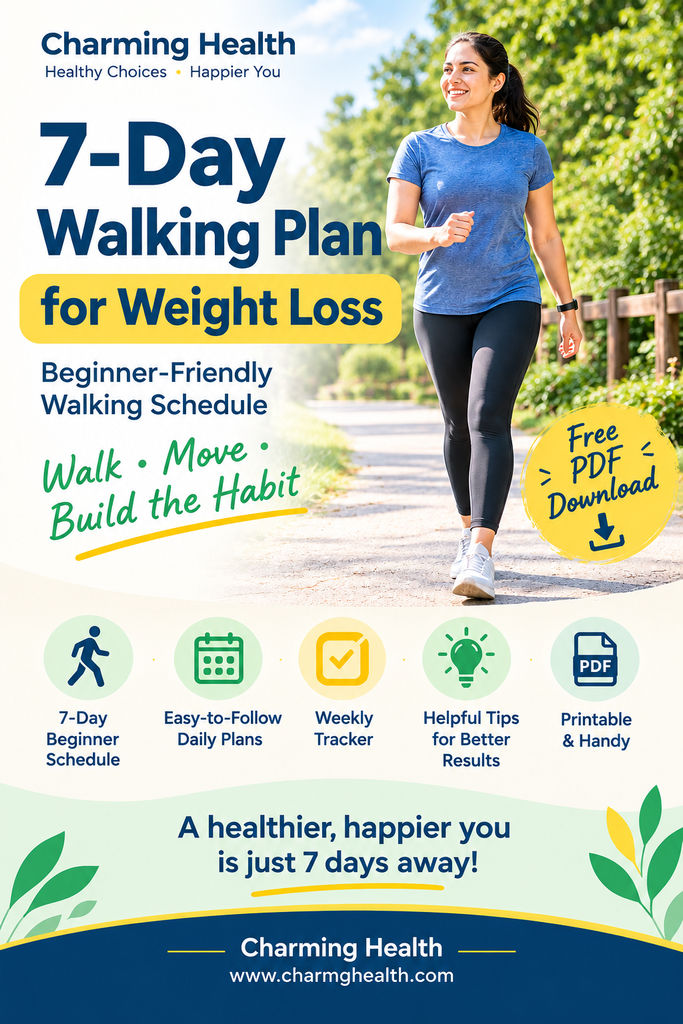
Free Walking Plan for Weight Loss PDF
Want to keep this walking schedule on your phone or print it out?
Download our free walking plan for weight loss PDF and use it as your weekly checklist.
👉 Download the Free Walking Plan for Weight Loss PDF
PDF contents:
- 7-day beginner walking schedule
- Daily walking time
- Easy and brisk walking instructions
- Weekly progress tracker
- Walking habit checklist
- Space to record your daily steps
How to Continue After the First 7 Days
Completing one week is only the beginning.
Don’t feel that you need to dramatically increase your walking time during Week 2.
Instead, choose one small progression.
For example:
Option 1: Add 5 minutes
Increase one or two walking sessions by 5 minutes.
Option 2: Add another brisk interval
Keep the same walking duration but add one additional short brisk interval.
Option 3: Increase daily movement
Keep your planned walk the same and look for additional opportunities to move during the day.
The CDC recommends gradually increasing activity rather than trying to do everything immediately.
Over time, you can work toward meeting or exceeding the general guideline of 150 minutes of moderate-intensity aerobic activity per week, depending on your individual goals and fitness level.
A Simple Walking Routine You Can Actually Maintain
The most useful walking plan isn’t necessarily the hardest one.
It’s the one you can continue.
You don’t need to walk for two hours every day, hit 10,000 steps immediately, or exercise at maximum intensity.
Start where you are.
Walk regularly.
Increase your activity gradually.
Combine walking with a balanced eating pattern.
And give yourself enough time to see changes.
Weight loss doesn’t happen at exactly the same rate for everyone. The CDC notes that gradual, sustainable weight loss is generally more realistic than trying to lose a large amount of weight very quickly.
Frequently Asked Questions
How much should a beginner walk to lose weight?
A beginner can start with around 15–20 minutes per walking session and gradually increase duration. This 7-day plan builds from 20 minutes toward 30–35-minute sessions.
Is walking 30 minutes a day enough to lose weight?
Thirty minutes of walking can contribute to your overall physical activity, but weight loss depends on several factors, including food intake and your total daily activity. Regular walking is one useful part of a healthy weight-management plan.
Is it better to walk fast or slow for weight loss?
Brisk walking generally provides more moderate-intensity activity than a very slow walk. However, beginners should start at a comfortable pace and gradually increase intensity.
Can I split my walking into two sessions?
Yes. If you don’t have time for one long walk, splitting your activity into shorter sessions can make it easier to fit movement into your day.
Should I walk every day?
You can include some form of walking every day if it feels comfortable, but not every day needs to be a challenging workout. This plan deliberately includes easier days.
Can walking help reduce belly fat?
Walking can contribute to overall calorie expenditure and weight loss, which may eventually reduce waist fat. However, you cannot control exactly where your body loses fat.
Do I need 10,000 steps a day?
No. Ten thousand steps isn’t a requirement for weight loss. Start with your current activity level and gradually increase your daily movement.
Can I do this walking plan on a treadmill?
Yes. The same schedule can be performed outdoors or on a treadmill. You can adjust the speed according to your fitness level.
Final Takeaway
This 7-day walking plan for weight loss is designed to make getting started simple.
You don’t need to be an experienced exerciser.
Start with manageable walks, introduce short periods of brisk walking, include easier recovery days, and gradually increase your activity.
Most importantly, don’t judge your progress after just seven days.
Use the first week to build the habit.
Then continue progressing gradually while pairing regular walking with a balanced eating pattern and other healthy lifestyle habits.
Ready to go deeper? Read the complete Walking for Weight Loss guide for more information about walking time, pace, steps, and weight loss.
Recommended Walking Equipment

- Minimalist Operation: Start walking pad with just one button – exercise has never been this effortless! No complicated s…
- Professional Shock Absorption: Walking pad treadmill protects your knees scientifically – every step is gentle! Equipped…
- Whisper-Quiet Motor: Powerful and quiet caminadoras para hacer ejercicio – no disturbing others when working out! Powere…

- THE T5 TREADMILL – See your live workout stats on the clear LCD display or use your own device to follow iFIT trainers a…
- 0-10 MPH – Run, jog, or walk at speeds of up to 10 MPH. Perfect for home workouts, cardio training, and endurance buildi…
- 0-10% INCLINE – Increase calorie burn and target more muscle groups with a 0–10% incline range.

- Powerful Motor – This walking pad adopts an advanced motor which can reach speed of 0.6-3.8 mph and can withstand 220 po…
- LED Display & Remote Control – Our walking pad treadmill is equipped with LED Display, showing speed, distance, time and…
- Compact & Space Saving Design – The under desk treadmill measures 47.2 x 19.6x 4.6 inches which is ready to use out of t…
More From Charming Health
- Walking for Weight Loss: How Much Should You Walk to Lose Weight?
- 7-Day Weight Loss Meal Plan: High-Protein, High-Fiber & Easy
- 30 Healthy Pakistani Recipes: Easy, High-Protein & Lower-Oil Favorites
- Lower Back Pain Relief Stretches You Should Try Today
Charming Health | www.charmghealth.com